One of the pleasures of writing is being able to share not only information and ideas but also one’s feelings about them, but that opportunity rarely comes when doing office memos or straight news journalism. This is because by tradition, most of the sentences of office memos and straight news need to be in the normal subject-verb-complement (S-V/C) pattern: “We launched this widget last week,” “Angela de Mesa did this to someone”—that sort of thing.
In journalism, of course, feature writing rather than just straight news reporting is called for to evoke feeling and emotion about the subject at hand. Take this featurized sentence: “When it comes to doing native-motif woodcarvings, few can beat the artisans of Pakil for sheer craftsmanship.” Its normal S-V/C form is, of course, “Few can beat the artisans of Pakil for sheer craftsmanship when it comes to doing native-motif woodcarvings.” By departing from this norm, the featurized sentence even more strongly conveys certitude and conviction. This reordering of sentence elements enliven otherwise bland statements, and true inversions—the kind whose sentence elements are transposed within the main clause itself—simply carry that process to even more arresting, often even more pleasing extremes.
We already know that the need to emphasize is the strongest motivation for inverting sentences, and that one way of achieving emphasis is to put simply the sentence complement up front. (Recall that in English grammar, a complement is a word or word group that completes the predicate in a sentence.) In my previous columns on inversion, we also saw that frontlining the complement—or putting the focus on specific aspects of location, time, or movement as well as shades of meaning—has the added virtue of making a sentence a smooth transitional device.
Now we will look closely at a few more inversion schemes—and more pragmatic ones at that. To fully appreciate their semantic value, however, it’s best to imagine the sample inverted sentences to be given below as being preceded by normal S-V/C sentences. We can then feel more strongly how well the inversion works. The semantic alchemy that inversion performs is, of course, difficult to explain, but there’s absolutely no doubt about its power to perk up prose.
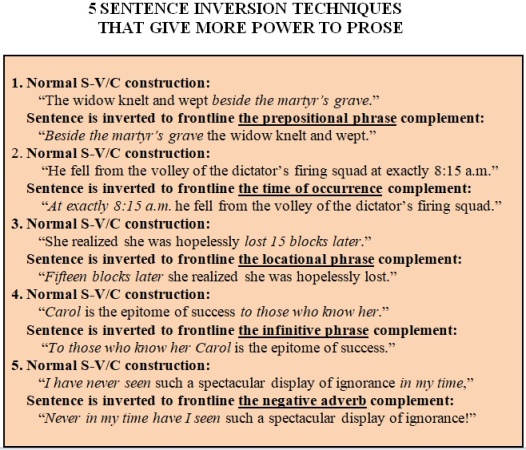
Prepositional phrase as frontline complement: “Beside the martyr’s grave the widow knelt and wept.” This inverted C-S-V sentence powerfully conveys emotion, while its S-V/C construction comes comparatively flat: “The widow knelt and wept beside the martyr’s grave.”
Time of occurrence as frontline complement: “At exactly 8:15 a.m. he fell from the volley of the dictator’s firing squad.” This inverted sentence has an ever so subtle emotional tug, while its S-V/C construction hardly has any: “He fell from the volley of the dictator’s firing squad at exactly 8:15 a.m.”
Locational phrase as frontline complement: “Fifteen blocks later she realized she was hopelessly lost.” This inverted sentence conveys heightened feeling, while its S-V/C form is decidedly deadpan: “She realized she was hopelessly lost 15 blocks later.”
Infinitive phrase as frontline complement: “To those who know her Carol is the epitome of success.” The sense of immediacy of this inverted sentence (without a comma before “Carol”) is much greater than that of its S-V/C pattern: “Carol is the epitome of success to those who know her.”
We know, of course, that the English language reserves its much deeper sentence inversions to express highly emotional states, such as pleasure, passion, frustration, disgust, and anger as well as fierce advocacy and deeply held belief. (At the very top of the inversion spectrum is poetry, which we won’t take up here.).
Of the deep inversion schemes, here are some of the most useful:
Frontlining negative adverbs for emphasis: “Never in my time have I seen such a spectacular display of ignorance!” This is obviously much more emphatic than its S-V/C version, “I have never seen such a spectacular display of ignorance in my time,” thus truly meriting the exclamation mark.
Deep C-S-V inversion for emphasis: “Four times I read the book before I could put it down.” Its S-V/C pattern is much less compelling: “I was able to put the book down only after reading it four times.”
Fronting a noun or adjective complement for emphasis: “‘Precious’ is the word that I use to describe/all the feelings I have for you deep down inside.” These lyrics of the old song are, of course, an inversion of this longwinded, confusing S-V/C sentence: “The word that I use to describe all the feelings I have for you deep down inside is ‘precious’.” (Now we know one good reason why song lyrics of this type are not only memorable but pleasurable as well.)
Extraposition of a relative clause for rhetorical purposes: “A woman came in who had nine toddlers and a solitary goat in tow.” Here’s its normal S-V/C form: “A woman who had nine toddlers and a solitary goat in tow came in.” By delivering the verb “came in” much earlier, the inverted sentence reads much better both silently and aloud. This extraposition is thus very useful to spoken narratives and speeches.
This ends our discussion of inverted sentences. Dare anybody at this point still say that he or she can’t perk up an exposition by inverting at least a sentence or two?
This essay, which first appeared in my weekly column “English Plain and Simple” in The Manila Times
, subsequently became Chapter 73 of my book Giving Your English the Winning Edge
, ©2009 by the Manila Times Publishing Corp. All rights reserved.Read this essay and listen to its voice recording in The Manila Times
:Using inversion for even stronger emphasisNext week:
Some baffling aspects of inverted sentences (February 27, 2025)
Visit Jose Carillo’s English Forum, http://josecarilloforum.com. You can follow me on Facebook and X (Twitter) and e-mail me at j8carillo@yahoo.com.

