« on: February 10, 2025, 04:19:58 PM »
GET A STRONGER GRASP OF FREQUENT ENGLISH GRAMMAR MISUSES(Third of a weekly series) February 11, 2025To further reinforce your English grammar footing in 2025, Jose Carillo’s English Forum is running every Tuesday starting last January 28, 2025 a series of very common English grammar misuses even by not just a few of its native speakers. This week we’ll continue the series by clarifying 6 more such misuses (number 13 to 18 in the series) from about 480 that have been taken up in the Forum’s Use and Misuse board over the years, mostly in response to questions raised by Forum members and readers.13. “The proper use of ‘can’ and ‘may’ as a mark of civility”Very basic but admittedly baffling questions posed by Forum member Mylabskie in April 2017: “When should we use ‘may’ and ‘can’? When do we say ‘Can I go out?’ and ‘May I go out’?”

My reply to Mylabskie: We use the modal verbs “may” or “can” (1) to express possibility, (2) to denote the capacity to do something, or (3) to express permission or ask for it. For this third purpose, our choice between “may” and “can” depends on the level of formality of the situation and on the social or professional rank or relative seniority between the speaker and listener.
As a general rule, “can” leans towards the informal side of saying things, and “may” towards the formal side. I must point out though that this distinction between “can” and “may” is often not very well understood and appreciated even by nonnative speakers of English. As explained in detail in the Forum’s reply to Mylabskie, it often takes years of social interaction in formal settings or situations for them to grasp and internalize the usage differences.
14. “Questionable usage of the word ‘boring’ in a K-12 English module”
Question sent to my Personal Messages box by Forum Member Baklis in March 2015: “As I skimmed through an English module for K-12*, I came across this sentence construction: ‘His song is boring to hear.’ Take note that the word ‘boring’ is used as a present participle in that sentence, but it seems to me that there’s something wrong with that sentence. For me, the word ‘boring’ there functions as an adjective and not as a participle. Please do shed light on this.”

My reply to Baklis: You’re right in your perception that something’s wrong with this sentence from that K-12 English module: “His song is boring to hear.” It’s actually a redundant construction for the succinct “His song is boring,” in which it’s unmistakable that the word “boring” is an adjective rather than a present participle as indicated by that module. By definition, the adjective “boring” means “causing boredom” or “tiresome,” a state of mind or condition that in the context of, say, a song is obviously perceived through the sense of hearing, so it’s superfluous—needless—to still qualify it with the modifying phrase “to hear.” (It’s as awkward as saying “Her home-cooked lasagna is satisfying to eat.”)
15. Question posted by a Forum Member in November 2009: “Can we use ‘too’ and ‘either’ interchangeably?”
My reply to Forum Member Sky: No, Sky, “too” and “either” aren’t interchangeable at all. The adverb “too” means “besides” or “also,” as in “All these and heaven, too.” The sense is additive. In contrast, “either” gives the sense of an alternative. It’s often used as a conjunction to indicate that what immediately follows a certain item is the first of two or more alternatives, as in “Take this either as a gift or a voluntary contribution.” Even when “either” is used as an adverb, it means “likewise” or “moreover” but only in the sense of giving emphasis after a negative, as in “She isn’t popular or likable either.”

Forum members Hill Roberts and Bunty (pseud.) each posted a response to Sky’s question.
16. “The mood of the sentence determines whether ‘I’ is to be followed by ‘was’ or ‘were’”
Forum Member Miss Mae posted this grammar dilemma of hers in July 2010: She said that she had been taught in elementary school that the grammatically correct usage is for the first-person personal pronoun “I” to be always followed by “were” (the plural past tense of the verb “be”). However, she said that she had always found it more “comfortable” to use “was” (the singular past tense of “be”) in such instances. That her choice of “was” correct was confirmed by that word’s use in the title of the 1957 film I Was a Teenage Werewolf, but it was contradicted by Frank Lloyd’s use of “were” for the singular noun “king” in the title of his 14th film If I Were King. Miss Mae thus asked the Forum for advice on whether to discard her long-time personal preference for “was” in such sentence constructions and revert to “were” as she had been taught in grade school.
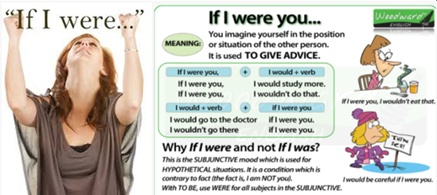
My reply to Miss Mae: I’m sorry to say that you got it wrong that the first-person personal pronoun “I” should always be followed by the past-tense form of the verb “be,” which is “were.” Your elementary-school English teacher was clearly misinformed and evidently confused about that usage, and the fact that you personally decided it was more comfortable to use the past-tense form “was” tells me that you instinctively knew better grammar than your grade school English teacher.
To clearly understand the distinction between these usages, we need to do a quick review of the three moods of verbs in English. By mood, of course, we mean that aspect of the verb that expresses the state of mind or attitude of the speaker toward what he or she is saying. The three moods are the indicative mood, the imperative mood, and the subjunctive mood, which were explained in detail in the Forum’s reply to Miss Mae.
17. “No need to hold ‘celebrant’ in a semantic straightjacket”
The Philippines being a predominantly Roman Catholic country, there’s a tendency for the supposedly English-savvy among us to scoff at people who describe as a “celebrant” someone celebrating a birthday or some other auspicious occasion. “Oh, no, that isn’t right!” they’d often cut off and gleefully heckle the speaker. “The right word is ‘celebrator’; ‘celebrant’ means a priest officiating the Holy Mass!”

But are people who use “celebrator” in that context really wrong? Do they really deserve all that heckling? Sometime ago, after witnessing yet another savage if good-natured ribbing that someone got for using “celebrant” to mean a birthday “celebrator”, I decided to look deeper into the usage by checking and counterchecking with four leading and authoritative English dictionaries.
18. “Are you correctly using ‘between’ and ‘among’?”
Until my college days I used to be supremely confident of choosing correctly between the prepositions “between” and “among.” This was because my grade-school grammar teachers had so efficiently drilled into my brain this very simple rule: “Use ‘between’ for two, and use ‘among’ for more than two.” The rule worked very well indeed for sentence constructions involving twosomes, like “The bond between Eduardo and Alberto is very strong,” and for those involving threesomes or more, like “Choosing from among three or five job applicants is easy.” I hardly batted an eyelash when making the choice.
But there finally came a time when I began to have my doubts. Using “between” rarely gave me problems, but there were far too many situations when using “among” for threesomes or more simply didn’t seem right. Sentences like the following particularly baffled me: “The chiffon cake was divided among Ana, Gloria, and Julia.” “The stewardess had mud among her fingers.” In all two cases, “among” seemed to me a grammatical misfit and “between” a more natural choice—which was confirmed by my further research on the matter.
--------------
*The K to 12 curriculum in the Philippines covers Kindergarten and 12 years of basic education.
Watch out for the 4th of this series next Tuesday (February 18, 2025)!
« Last Edit: February 11, 2025, 10:04:09 AM by Joe Carillo »

Logged


